Bolts for high heat can become a weak point in industrial equipment when buyers select them by material name or room-temperature strength alone. Heat can reduce strength, accelerate oxidation, and cause preload loss over time.1 I help customers narrow the choice by reviewing the actual service conditions, joint design, material requirements, and documentation expectations.
The best bolts for high heat are not defined by one universal alloy or maximum-temperature claim. A suitable high-temperature bolting system must retain adequate strength and preload at the actual metal temperature while resisting creep, relaxation, oxidation, corrosion, and thermal cycling. Buyers should evaluate the complete joint—including bolts, nuts, washers, load, atmosphere, and specifications—before approving a material.
A bolt can remain physically intact after heating and still fail its functional purpose. That distinction matters in procurement. The sections below explain how I would frame high-temperature fastener selection questions, compare material directions without oversimplifying them, and build a more reliable supplier-evaluation checklist.
Why Are Bolts for High Heat a Joint-Reliability Question?
Bolts for high heat often create problems when the discussion starts and ends with the bolt material. A buyer may choose an alloy that resists heat, yet the connection can still lose clamp load because of creep, thread friction changes, joint movement, or incompatible nuts and washers. I encourage buyers to evaluate the complete bolted joint.
A high-temperature bolt is suitable only when the entire joint can maintain its required preload and mechanical integrity during service.2 This requires confirmation of elevated-temperature strength, creep resistance, stress relaxation, thermal expansion, service atmosphere, fastener geometry, mating components, tightening method, and time at temperature—not simply a material grade printed on a certificate.
A Bolt That Survives Heat May Still Lose Preload
In technical inquiries, I often see an initial request that names a material grade, diameter, and quantity. Those details are necessary, but they do not fully describe whether the bolted connection will work under heat. The key question is often not “Will the bolt melt?” It is “Will the joint retain the clamp force needed during its service life?”
A bolted joint depends on preload. Preload is the controlled tension created when the bolt is tightened. That tension creates clamping force across flanges, covers, brackets, pressure boundaries, or equipment assemblies.
At elevated temperature, several mechanisms may reduce that preload:
- Bolt creep: The bolt may deform slowly under sustained stress and heat.
- Stress relaxation: The bolt can lose stress while held at a fixed extension.
- Joint embedment: Surface irregularities in threads, washers, or mating faces can settle further.
- Differential thermal expansion: The bolt, nut, washers, flange, and connected components may expand at different rates.
- Oxidation or corrosion: Surface attack can affect section thickness, thread condition, or tightening behavior.
- Thermal cycling: Repeated heating and cooling may change load distribution and increase fatigue risk.
For example, a fastener may have acceptable room-temperature tensile strength, but that figure does not establish its performance after prolonged exposure at the actual operating temperature.3 The relevant property may be elevated-temperature yield strength, creep resistance, stress-rupture behavior, or relaxation performance under a specified time and stress condition.
I treat a high-temperature fastener as one part of a controlled assembly, not as an isolated piece of hardware.
Questions That Define the Joint
Before a buyer approves bolts for high heat, I recommend collecting the information below. These details help engineering, quality, and procurement teams avoid assumptions.
| Joint factor | Why it matters | Typical confirmation point |
|---|---|---|
| Actual metal temperature | Metal temperature can differ from gas or process temperature | Normal, peak, and transient temperature |
| Exposure duration | Short excursions and continuous operation create different risks | Hours per cycle, total operating life |
| Required preload | Clamp load affects stress in the bolt | Torque, tension, or joint-load requirement |
| Thermal cycles | Repeated cycles can affect fatigue and preload retention | Startup/shutdown frequency |
| Mating materials | Different expansion rates can alter joint load | Flange, housing, nut, washer materials |
| Service atmosphere | Oxidizing, carburizing, sulfur-bearing, chloride-bearing, or reducing conditions may change material behavior | Process gas, moisture, chemicals, deposits |
| Joint geometry | Grip length, thread engagement, and washer arrangement affect load distribution | Drawing, assembly stack-up, thread details |
I have found that a clear drawing revision and a complete bill of materials are especially useful. A request for “high heat bolts” may involve stud bolts, heavy hex bolts, socket head cap screws, nuts, and washers. Each component needs to be considered as part of the same system.
Which Materials Can Be Considered for Bolts for High Heat?
Bolts for high heat are often specified from heat-resistant stainless steel or nickel-based alloy families, but neither family is automatically correct. Buyers can face costly rework if they treat an alloy name as a guarantee of performance. The operating environment, required mechanical properties, and governing specification must guide the material direction.
Heat-resistant and stabilized stainless steels may suit some elevated-temperature applications, while nickel-based alloys may be considered where more demanding strength, oxidation, or corrosion conditions apply. However, buyers should verify each grade’s properties at service temperature, heat-treatment condition, product form, and applicable standard before making an application-specific decision.
Start With Material Families, Not a Universal Ranking
I avoid presenting a single list of “best high-temperature bolt materials.” That approach can encourage unsuitable substitution. Material selection should begin with the service condition and the project specification.
For industrial fasteners, the material families that may enter a high-temperature discussion include:
- High-temperature and stabilized austenitic stainless steels, such as 304H, 316Ti, 321, 347, and 347H.
- Precipitation-hardening stainless steels, such as 17-4PH or Type 630, where the required condition and elevated-temperature limits need careful verification.
- Nickel-based alloys, including selected Inconel and Incoloy families, when the service condition calls for verified high-temperature strength, oxidation resistance, or corrosion resistance.
- Other specialty alloys, where a customer’s drawing, project standard, or approved material list specifies them.
Each family has trade-offs. A material with favorable oxidation resistance may not be the best choice for the required sustained load. A material with high strength in one condition may require confirmation of its properties after exposure to the relevant temperature. A material accepted in one process atmosphere may not be acceptable in another.
Why Room-Temperature Data Is Not Enough
A material test certificate may show chemical composition and room-temperature mechanical values. Those documents are important, but they may not answer the full high-temperature question.4
For bolts for high heat, buyers should ask whether the required specification addresses:
- Elevated-temperature tensile or yield properties
- Creep behavior under sustained stress
- Stress-rupture performance
- Hardness and heat-treatment condition
- Resistance to oxidation, scaling, or process corrosion
- The expected service duration and thermal-cycle profile
A room-temperature yield-strength value should not be used as the main basis for a high-temperature joint decision.5 The bolt’s stress level during installation and operation may be significantly more relevant than a simple ambient-temperature comparison.
Grade Names Do Not Mean Automatic Equivalence
In export inquiries, customers may reference trade names, UNS numbers, ASTM designations, EN material numbers, or internal project descriptions. I recommend confirming exactly what the purchaser requires.
A name that appears similar does not prove equivalence between:
- Different national or international standards
- Bar, forging, or finished-fastener product forms
- Solution-treated, aged, annealed, or other heat-treatment conditions
- Material certificates with different test requirements
- Standard fasteners and custom machined parts
For example, a drawing may require a specific alloy, a defined mechanical-property condition, and a particular inspection plan. An alternate grade with a similar headline description should not be assumed acceptable without written technical approval from the responsible engineering authority.
| Procurement question | Risk if unanswered | Better approach |
|---|---|---|
| “Can you offer a similar alloy?” | Unapproved substitution | Request written acceptance criteria |
| “What is the maximum temperature?” | Oversimplified selection | Confirm actual metal temperature, load, time, and atmosphere |
| “Is the bolt high strength?” | Room-temperature data may mislead | Review elevated-temperature requirements |
| “Can we use standard nuts?” | Mismatched joint components | Specify compatible nuts and washers |
| “Is this material certified?” | Certificate scope may be unclear | Define required documents and traceability |
I can support customers by reviewing requested materials, dimensions, drawings, and document requirements for quotation purposes. However, the final material suitability for a specific operating condition should be confirmed by qualified engineering professionals and against the applicable project standard.
How Should Buyers Specify and Source Bolts for High Heat?
Bolts for high heat can be difficult to source consistently when specifications leave important details open to interpretation. A supplier may quote the correct nominal diameter but a different material condition, thread standard, nut pairing, or inspection scope. I recommend converting service needs into a documented purchasing requirement before comparing offers.
Buyers should source high-temperature bolts through a controlled specification that defines material, product form, dimensions, threads, heat-treatment condition, mechanical-property requirements, mating hardware, inspection, certificates, traceability, and approved deviations.6 The most reliable quotation comparison is based on the same complete technical package for every supplier.
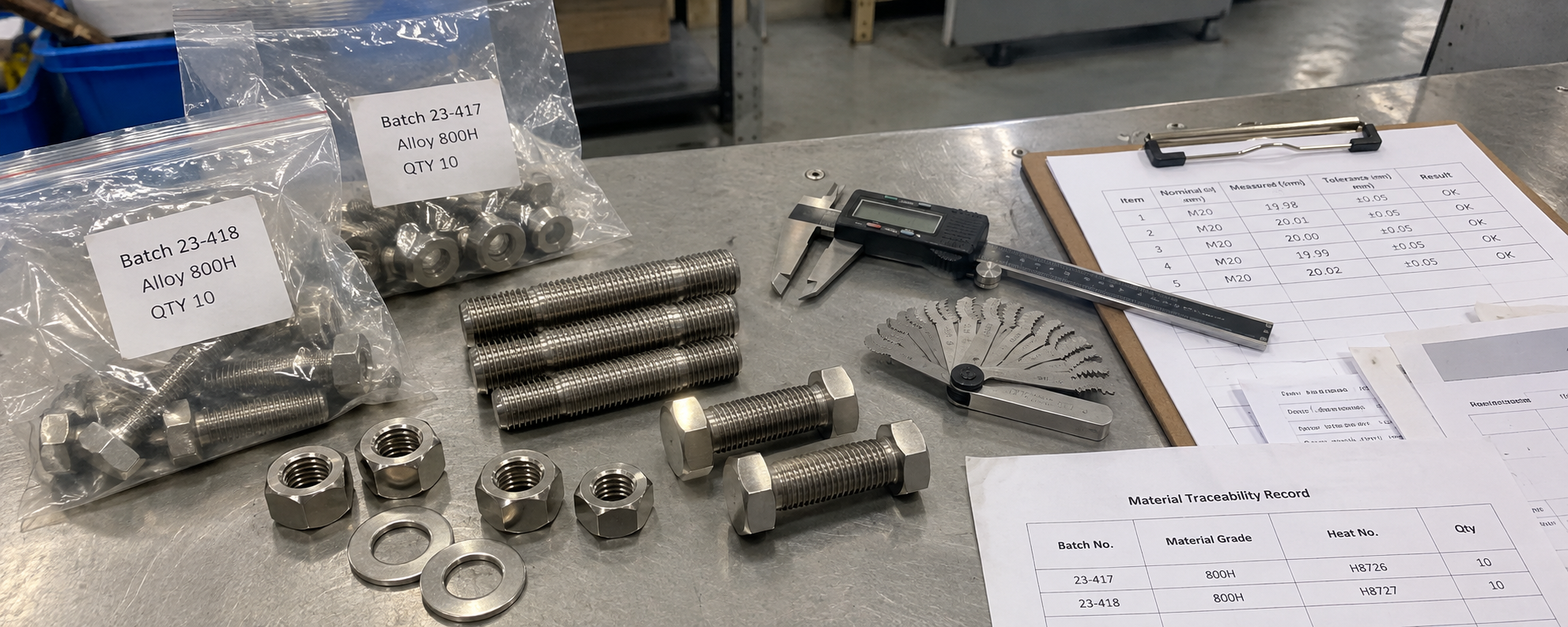
Build a Practical Technical Confirmation Checklist
In technical inquiries, the information that typically needs confirmation includes the following:
- Actual metal temperature: Include normal operating temperature, peak temperature, and expected excursions.
- Exposure time: Identify continuous service, intermittent service, or shutdown cycles.
- Fastener type: Define whether the requirement is for hex bolts, heavy hex bolts, stud bolts, threaded rods, socket head cap screws, nuts, washers, or a complete set.
- Material requirement: State the exact grade, standard, product form, and permitted alternatives.
- Heat-treatment condition: Specify the required condition if applicable.
- Dimensions and threads: Include diameter, pitch, length, thread length, tolerance, and thread standard.
- Joint configuration: Clarify grip length, flange or component materials, and washer requirements.
- Load and tightening method: Provide required preload, torque procedure, tensioning method, or assembly standard where available.
- Service atmosphere: Identify oxidation, moisture, chlorides, sulfur compounds, process media, or other relevant exposure.
- Inspection requirements: Define chemical analysis, mechanical testing, dimensional inspection, thread gauges, NDT, PMI, or customer-specific checks where required.
- Documentation: State whether the project requires material test certificates, heat/lot traceability, inspection reports, packing lists, or third-party inspection.
This level of detail helps a supplier understand what is being purchased. It also helps the buyer compare quotations on a like-for-like basis.
Evaluate Manufacturing Controls, Not Only Unit Price
A lower quotation can appear attractive until the buyer discovers that it excludes a required document, uses a different raw-material source, or does not include matching nuts and washers. For critical applications, supplier selection should include quality-control capability and communication quality.
When I review a potential order, I believe these questions are useful:
- Can the supplier confirm the requested material and product standard?
- Can the supplier manufacture the required dimensions and thread form?
- Can the supplier provide the specified inspection records?
- Can material identification be maintained through production and packing?
- Can the supplier identify any technical deviation before production?
- Can the supplier provide matching nuts and washers with defined materials?
- Can the supplier meet the required quantity, lead time, and shipping arrangement?
For custom specialty alloy fasteners, a drawing review is often necessary before a firm manufacturing commitment. The drawing should show the latest revision, tolerances, threads, surface requirements, and any special inspection points. I have seen that early clarification can prevent later disagreement about what “as per drawing” actually means.
Treat Nuts and Washers as Controlled Components
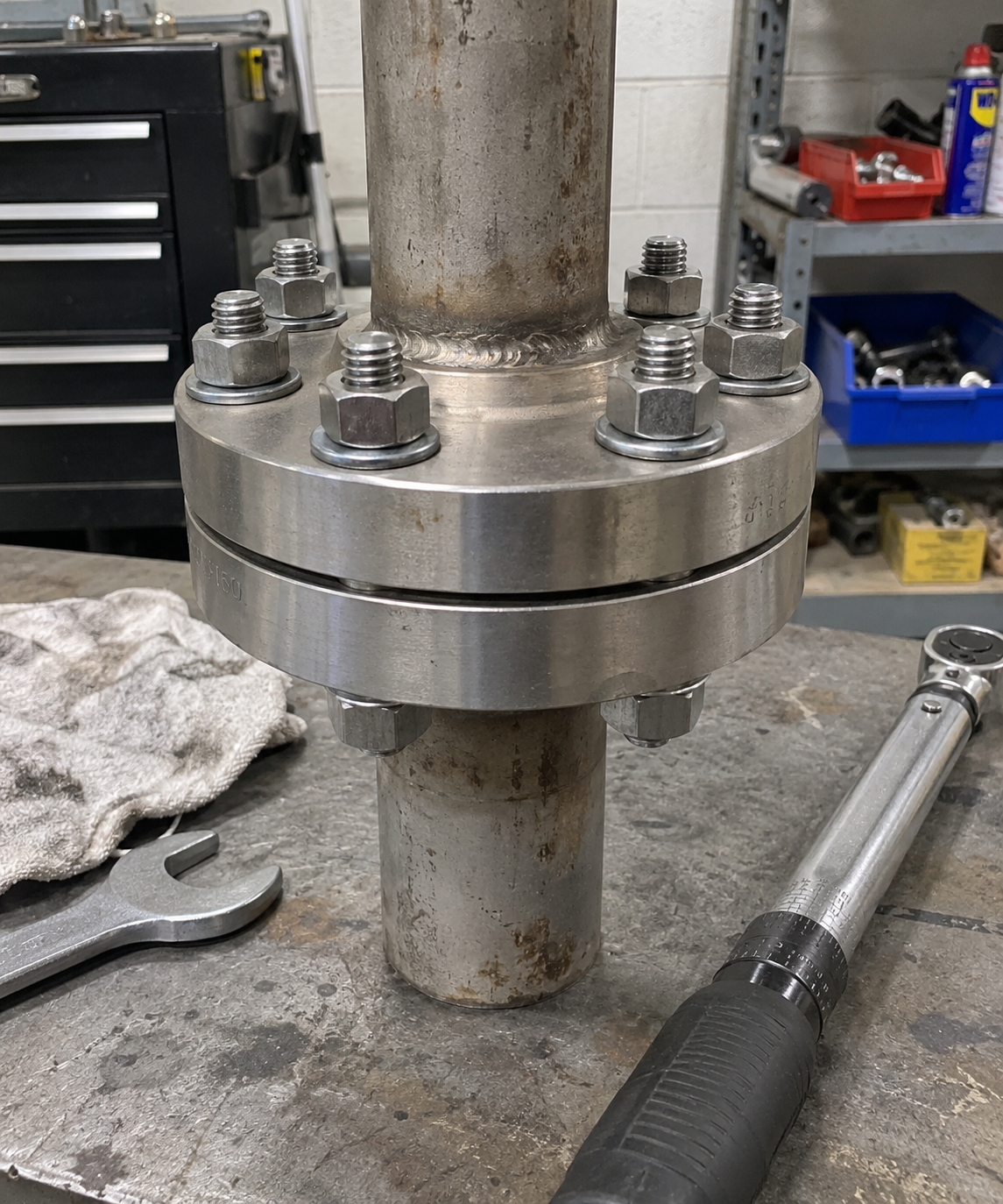
A high-temperature bolted assembly should not combine a carefully selected bolt with unspecified mating hardware.7 Nuts and washers influence friction, thread engagement, bearing stress, and preload consistency.
Buyers should confirm:
- Nut grade and material
- Washer material, hardness, and dimensions
- Coating or surface condition, if any
- Lubrication or assembly compound requirements
- Thread engagement length
- Compatibility with the selected tightening method
- Any project requirement for matched sets
The right bolt material cannot compensate for an incomplete joint specification. I recommend that procurement teams request a complete fastener assembly description whenever the application is sensitive to heat, pressure, vibration, corrosion, or repeated thermal movement.
Frequently Asked Questions
What is the best material for bolts for high heat?
There is no single best material for all high-temperature bolting applications. Heat-resistant stainless steels and nickel-based alloys may be considered depending on temperature, sustained load, exposure duration, atmosphere, thermal cycling, and project requirements. A qualified engineer should verify the final material choice against the applicable standard.
Why do high-temperature bolts lose tightness?
High-temperature bolts can lose tightness because of creep, stress relaxation, embedment, oxidation, differential thermal expansion, and repeated thermal cycling.8 The bolt may remain unbroken while the joint loses preload. Buyers should assess the bolt, nut, washer, mating parts, and tightening method as one system.
Are stainless steel bolts suitable for high heat?
Some stainless steel grades are used in elevated-temperature equipment, but suitability depends on the exact grade, heat-treatment condition, stress level, time at temperature, and service atmosphere.9 Buyers should not assume that all stainless steel bolts have the same high-temperature performance or corrosion resistance.
Should I specify bolts, nuts, and washers together?
Yes. The nut and washer materials, geometry, thread engagement, and surface condition can affect preload and joint reliability. For high-temperature assemblies, I recommend specifying the complete fastening set and confirming any required tightening procedure, lubrication, inspection, and traceability documentation.
What documents should I request for high-temperature fasteners?
Document requirements depend on the project, but buyers may request material test certificates, chemical composition records, mechanical-test reports, dimensional and thread-inspection records, heat or lot traceability, and third-party inspection reports where specified. The purchase order should clearly define the required document standard and acceptance criteria.
Conclusion
Bolts for high heat should be selected as part of a complete joint, not by choosing the strongest-looking alloy name or relying on room-temperature tensile data. Buyers should confirm actual metal temperature, time under load, creep and relaxation concerns, thermal cycling, service atmosphere, joint geometry, and the compatibility of nuts and washers. At CHENGGE, I can help industrial buyers review drawings, material requirements, dimensions, and documentation needs for specialty alloy fasteners and custom machined components. Send your inquiry to [email protected] with your drawing or specification for a practical quotation review.
"Influence of Cr Content on the High-Temperature Oxidation ...", https://pmc.ncbi.nlm.nih.gov/articles/PMC10383239/. Research on bolted joints at elevated temperatures shows that strength reduction, oxidation, and preload loss are well-documented phenomena (e.g., Bickford, J.H., 'An Introduction to the Design and Behavior of Bolted Joints,' CRC Press). Evidence role: general_support; source type: research. Supports: The source should confirm that elevated temperature reduces tensile strength, accelerates oxidation, and causes preload loss in bolted joints.. Scope note: The exact magnitude of these effects depends on specific materials and conditions. ↩
"Guideline for Bolted Joint Design and Analysis: Version 1.0", https://www.osti.gov/servlets/purl/929124. Industry guidelines such as ASME PCC-1 and textbooks on bolted joints emphasize that preload retention and joint integrity depend on the entire assembly, not just the fastener material. Evidence role: definition; source type: institution. Supports: The source should define that high-temperature bolting requires joint-level evaluation, not just bolt material selection.. Scope note: This is a general engineering principle; specific applications may have additional requirements. ↩
"High-temperature tensile constitutive data and models for ...", https://nvlpubs.nist.gov/nistpubs/TechnicalNotes/NIST.TN.1714.pdf. Material property databases and standards (e.g., ASTM A193) show that tensile strength decreases significantly at elevated temperatures, and room-temperature data alone cannot predict creep or stress-rupture behavior. Evidence role: general_support; source type: research. Supports: The source should show that room-temperature tensile strength is not a reliable indicator of elevated-temperature performance.. Scope note: Some materials retain strength better than others; specific data are needed for each alloy. ↩
"Fastener & Material Testing", https://www.nasa.gov/wp-content/uploads/2023/07/fastener-and-material-testing.pdf. Engineering standards such as ASME Boiler and Pressure Vessel Code require elevated-temperature property data (e.g., allowable stress values from creep and rupture tests) for materials used in high-temperature service, not just room-temperature tensile data. Evidence role: general_support; source type: institution. Supports: The source should state that elevated-temperature properties (e.g., creep, stress-rupture) are required for high-temperature design, not just room-temperature data.. Scope note: Some applications may rely on room-temperature data if service temperature is low enough; the need for elevated-temperature data depends on the specific code or standard. ↩
"High Temperature Mechanical Properties of High Strength ...", https://pmc.ncbi.nlm.nih.gov/articles/PMC7890573/. ASME Section II Part D provides allowable stress values that decrease with temperature, reflecting the reduction in yield and creep strength; using room-temperature yield strength for high-temperature design can lead to unsafe joints. Evidence role: general_support; source type: research. Supports: The source should show that yield strength decreases with temperature and that design must use elevated-temperature values.. Scope note: For very short-term or low-stress applications, room-temperature data may be conservative, but this is not typical for sustained high-temperature service. ↩
"NASA-STD-5020A w/CHANGE 1", https://www.nasa.gov/wp-content/uploads/2018/01/nasa-std-5020a_w-chg_1_nasa_fastener_standards.pdf. Industry standards such as ASTM A193 and ASME B18.2.1 specify requirements for material, dimensions, heat treatment, and testing; a complete specification for high-temperature bolts should include these elements plus traceability and inspection. Evidence role: definition; source type: institution. Supports: The source should define the elements of a complete fastener specification for high-temperature service.. Scope note: The exact specification depends on the application and governing code; this is a general guideline. ↩
"Effect of Bolted Joint Preload on Structural Damping", https://digitalcommons.usf.edu/cgi/viewcontent.cgi?article=5991&context=etd. Engineering studies on bolted joints indicate that nut material, thread engagement, and washer hardness affect preload and joint integrity; mismatched components can lead to relaxation or failure at elevated temperatures. Evidence role: general_support; source type: research. Supports: The source should show that mismatched nuts and washers can cause preload loss, galling, or failure in high-temperature joints.. Scope note: Some applications may tolerate mismatched hardware if properly analyzed, but this is not recommended for critical service. ↩
"Study of Bolt Load Loss in Bolted Aluminum Joints - Rod Lakes", https://lakeslab.ep.wisc.edu/BoltJEMT07.pdf. Research on bolted joint behavior at elevated temperatures (e.g., Bickford, J.H., 'An Introduction to the Design and Behavior of Bolted Joints') identifies creep, relaxation, embedment, oxidation, differential expansion, and thermal cycling as causes of preload loss. Evidence role: mechanism; source type: research. Supports: The source should explain how each mechanism contributes to loss of tightness in high-temperature bolted joints.. Scope note: The relative contribution of each mechanism depends on specific conditions. ↩
"Elevated temperature ductility of types 304 and 316 ...", https://www.osti.gov/biblio/6490456. Materials handbooks (e.g., ASM Specialty Handbook: Stainless Steels) show that grades like 304H and 321 have different high-temperature strength and oxidation limits, and that heat treatment affects creep resistance. Evidence role: general_support; source type: research. Supports: The source should confirm that stainless steel performance at high temperature varies with grade, heat treatment, and service conditions.. Scope note: This is a general statement; specific data are needed for each grade and condition. ↩