UNF thread vs. UNRF thread comparisons often create avoidable purchasing risk because both designations can share the same diameter and thread pitch. A buyer may assume that matching threads per inch means full equivalence. However, that shortcut can cause specification, compliance, or fatigue concerns. I recommend checking the complete thread designation before approving a quotation or substitution.
UNF and UNRF are not two different fine-thread pitches. For the same nominal diameter, they can have the same threads per inch. The main distinction is that an external UNRF thread has a controlled rounded root, while a standard UNF designation does not impose the same UNR external-root requirement.1
The difference looks small on a purchase order, but it can be important in a cyclically loaded joint. I treat the designation as a technical requirement rather than a naming preference. The following sections explain what buyers should verify before they accept, quote, manufacture, or replace either thread form.
What Does UNF Thread vs. UNRF Thread Actually Mean?
Thread abbreviations can hide important manufacturing requirements. When a request lists only a diameter and pitch, suppliers may interpret the missing details differently. That uncertainty becomes more serious when a drawing requires a controlled external-thread root but the purchase order states only “UNF.”
UNF identifies the Unified National Fine thread series. UNRF identifies the UNR external thread form used within that fine-thread series. For the same nominal size, UNRF does not have a finer pitch than UNF. Its defining feature is the specified rounded root on the external thread.
The pitch series is not the key difference
I sometimes receive inquiries in which the customer asks whether UNRF has more threads per inch than UNF. That question is understandable because the additional letter looks like another pitch-series indicator. However, the “R” refers to the external-thread root form, not to a new pitch series.
For example, a buyer may compare designations such as:
1/2-20 UNF-2A1/2-20 UNRF-2A
Both examples use:
- A nominal diameter of 1/2 inch
- 20 threads per inch
- A fine-thread pitch
- An external-thread class indicated by the letter A
The distinction lies in the external root requirement. The exact acceptance limits and inspection method must come from the applicable standard, drawing, and specified edition. I do not recommend deriving production dimensions from a general online chart.
UNR requirements concern external threads
This point deserves special attention. The controlled rounded-root requirement applies to the external thread. Buyers should not assume that an internal thread receives an identical UNRF designation or root requirement.
In a typical mating arrangement, an external UNRF thread may engage with a compatible internal UN thread of the corresponding size, pitch, and class2. However, the buyer still needs to confirm the drawing and governing specification. The mating nut, tapped hole, insert, or other internally threaded component may carry its own designation and acceptance criteria.
| Item to compare | UNF | UNRF |
|---|---|---|
| Thread series | Unified National Fine | UNR form within the fine series |
| Pitch for the same stated size | Fine-series pitch | Same fine-series pitch |
| Controlled rounded external root | Not identified by the UNF designation alone | Required by the UNR designation |
| Application to internal threads | Internal UNF classes may be specified | The UNR root requirement concerns external threads |
| Automatic substitution approval | No | No |
| Governing authority | Drawing and applicable thread standard | Drawing and applicable thread standard |
I have seen inquiry spreadsheets that included only a size such as “3/4-16.” That information helps, but it does not fully define the product. I normally ask whether the thread is external or internal, which class applies, and whether the drawing calls for UNF or UNRF.
A matching diameter and pitch can establish possible mating compatibility, but it does not establish contractual equivalence.
Can UNF Thread and UNRF Thread Be Interchanged?
A supplier may have a matching UNF fastener available when a customer requests UNRF. The apparent fit can make substitution attractive, especially when a project faces a short deadline. However, availability does not remove the need for technical approval.
UNF and UNRF should not be treated as automatically interchangeable. A proposed replacement requires verification of the full designation, external or internal thread, class of fit, mating component, loading conditions, drawing notes, governing standard, and approval from the customer or responsible engineer.
Physical engagement is only one question
A fastener can sometimes engage with a mating component because its nominal diameter and pitch match. That fact answers a limited question: Can the parts screw together under certain conditions? It does not answer several other procurement questions:
- Does the supplied thread meet the drawing?
- Does the external root comply with the specified form?
- Does the class of fit match the requirement?
- Does the fastener meet the expected fatigue-related design assumptions?
- Does the inspection plan verify the required characteristics?
- Will the end user accept the deviation?
- Does the material and heat-treatment condition match the order?
I distinguish between functional assembly, dimensional compliance, and contractual compliance. The three concepts overlap, but they are not identical.
Thread class still matters
The suffix after the thread designation provides essential information. In Unified inch thread designations:
- A generally identifies an external thread.
- B generally identifies an internal thread.
- Classes such as 1, 2, and 3 indicate different fit and tolerance arrangements.
A UNRF-2A requirement should not be reduced to “fine thread.” The 2A element remains part of the specification. A supplier also should not assume that any internal thread with the same pitch is acceptable without checking the required internal class.
I ask for written deviation approval
In one anonymized inquiry, a customer’s request listed UNF in the purchasing sheet, while the attached drawing used UNRF in the thread callout. Instead of choosing one description, I asked the customer to confirm which document controlled. That clarification prevented us from quoting against an assumption.
When a substitution is proposed, I recommend a simple written process:
-
Identify the difference clearly.
State the offered thread designation and the required designation. -
Explain the reason for the proposal.
Common reasons include material availability, tooling, minimum order quantity, or lead time. -
Provide supporting production information.
The supplier should identify the intended standard, thread class, manufacturing route, and inspection plan. -
Request authorized approval.
The responsible customer representative or engineer should accept or reject the deviation. -
Preserve the approval record.
The purchase order, revised drawing, or deviation document should reflect the final decision.
Silence should never be treated as approval. A commercial quotation also should not quietly remove the “R” from the customer’s requested designation.
Does a UNRF Thread Improve Fatigue Performance?
The rounded external root is often associated with fatigue-sensitive applications. That connection can lead to broad claims that every UNRF fastener is stronger or safer. Such claims ignore the material, manufacturing process, joint design, load spectrum, and actual failure mode.
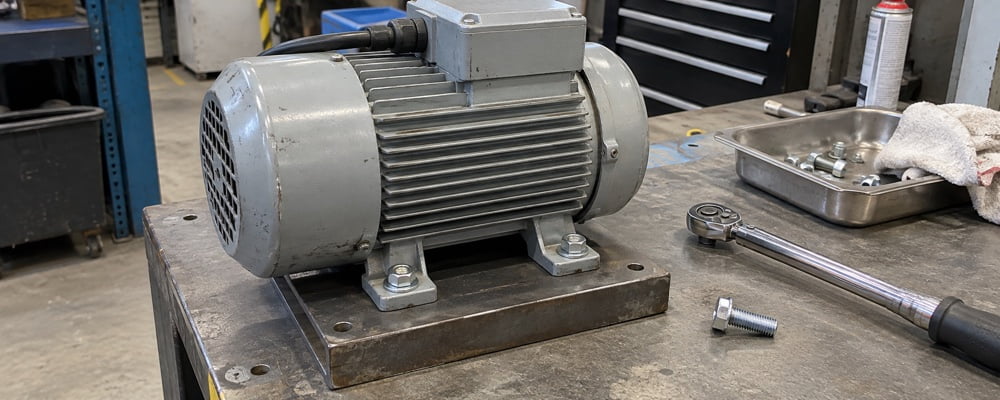
A controlled rounded external-thread root is intended to reduce stress concentration compared with a sharper root condition3, so it may support fatigue performance in an appropriately designed connection. However, the UNRF designation alone does not prove higher strength, longer service life, or suitability for a specific application.
Stress concentration is only part of the system
Thread roots are geometrical discontinuities. Cyclic loading can make local stress concentration important because fatigue cracks may initiate at highly stressed locations4. A controlled rounded root can reduce the severity of that local geometry compared with an inadequately controlled or sharper root.
However, I avoid assigning a universal percentage improvement. Any performance gain depends on variables such as:
- Nominal fastener size
- Applied mean and alternating load
- Material grade
- Heat-treatment condition
- Tensile strength and ductility
- Surface condition
- Thread manufacturing method5
- Residual stress
- Corrosion exposure
- Installation preload6
- Joint stiffness
- Alignment
- Service temperature
- Number and type of load cycles
A specialty-alloy fastener can also fail for reasons unrelated to the thread root. Examples include improper preload, hydrogen-related damage in susceptible systems, stress-corrosion cracking, galling, embrittlement, overload, unsuitable material selection, or a defective mating component.7
Material strength does not replace thread compliance
Our inquiries often involve materials such as Inconel alloys, Monel, duplex stainless steel, titanium, and precipitation-hardening stainless steel. A customer may focus heavily on the alloy name while overlooking the complete thread requirement.
However, an expensive alloy does not compensate for an incorrect designation. The buyer should separately confirm:
- Material specification and grade
- Heat treatment or condition
- Mechanical property requirements
- Thread designation and class
- Dimensional standard
- Surface or coating requirement8
- Inspection and documentation
- Traceability requirements
For example, an Alloy 718 fastener marked with the correct material designation may still be noncompliant if the drawing requires an external UNRF thread and the supplied part was manufactured and accepted only as UNF. Conversely, the presence of UNRF does not prove that Alloy 718 has the correct heat treatment or mechanical properties.
Cyclic loading should trigger more questions
When I see UNRF on a drawing, I ask whether the connection has a cyclic or fatigue-sensitive duty. I do not use the answer to redesign the joint. I use it to understand the risk of casually changing the thread callout.
Buyers should involve a qualified engineer when the fastener is used in:
- Rotating or reciprocating equipment
- Pressure-containing equipment
- Aerospace or transportation assemblies
- Offshore or marine equipment
- Vibration-prone machinery
- High-temperature cycling
- Safety-critical structural joints
The responsible engineer should evaluate the complete connection. A supplier’s general explanation cannot replace that review.
How Should Buyers Specify UNF Thread vs. UNRF Thread?
An incomplete purchase description transfers uncertainty to the supplier. The supplier may quote the most common interpretation, while the buyer expects a drawing-specific requirement. That gap can remain hidden until inspection, assembly, or final documentation review.
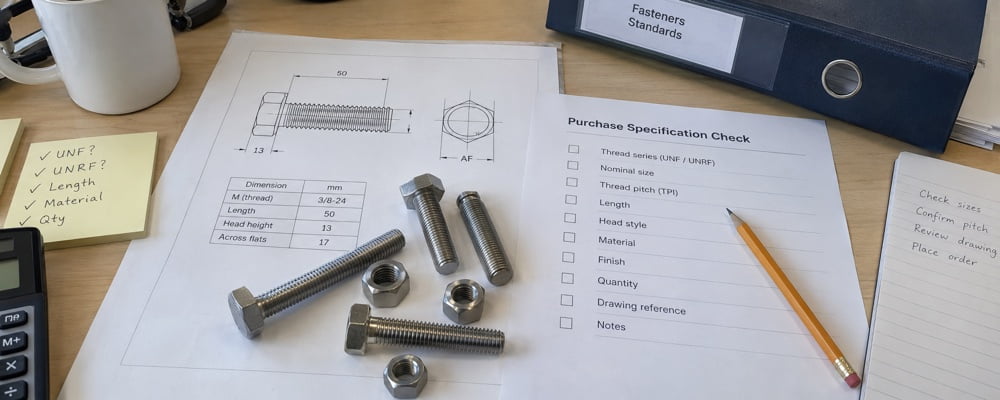
Buyers should specify the nominal diameter, threads per inch, UNF or UNRF designation, thread class, external or internal thread, governing standard and edition, part drawing revision, material, heat treatment, inspection requirements, quantity, and required documentation. The purchase order should match the approved drawing.
Start with the complete thread callout
A complete callout lets the supplier determine what must be manufactured and inspected. The exact format should follow the applicable drawing and standard. A description that says only “fine thread bolt” leaves too many open questions.
I recommend that buyers provide the following information:
| Specification field | Why it matters |
|---|---|
| Nominal diameter | Defines the basic thread size |
| Threads per inch | Defines the pitch |
| UNF or UNRF | Identifies the required series and external root form |
| Thread class | Establishes applicable fit and tolerance requirements |
| External or internal | Prevents misuse of the UNR concept |
| Thread length | Affects manufacturing and inspection |
| Governing standard and edition | Establishes the controlling technical requirements |
| Drawing number and revision | Prevents production against an obsolete document |
| Material grade | Defines the required alloy or material specification |
| Heat treatment or condition | Affects mechanical properties and manufacturability |
| Surface requirement | May affect dimensions, friction, and corrosion behavior |
| Inspection plan | Defines how conformity will be evaluated |
| Documentation | Defines certificates and traceability records |
Control conflicts between documents
Purchasing packages often contain several documents:
- Request for quotation
- Bill of materials
- Customer drawing
- Project specification
- Fastener standard
- Material standard
- Quality plan
- Purchase order
Those documents do not always agree. I have encountered packages where a spreadsheet omitted the thread class, while the drawing clearly specified it. I have also seen descriptions copied from an earlier revision.
The buyer should establish an order of precedence. If a conflict appears, the supplier should issue a technical query instead of selecting the easiest interpretation.
A useful clarification request can state:
“The request for quotation lists 5/8-18 UNF, while drawing revision C specifies 5/8-18 UNRF-2A. Please confirm the controlling designation and whether any deviation is permitted.”
This wording identifies the conflict without pretending that the supplier has authority to resolve it.
Avoid unsupported equivalency statements
Buyers should be cautious when a quotation uses phrases such as:
- “UNF equivalent to UNRF”
- “Same fit, so fully interchangeable”
- “Rounded root available if needed”
- “Same TPI means the same thread”
- “UNRF is always stronger”
Each statement requires clarification. The quotation should identify exactly what the supplier will manufacture, inspect, certify, and mark. If the root form is a requirement, the production and quality teams need an appropriate control method based on the applicable specification.
How Can Buyers Evaluate a UNRF Fastener Supplier?
A supplier may repeat the customer’s designation on a quotation without demonstrating that its production and inspection planning recognizes the distinction. Buyers therefore need to evaluate more than price, alloy availability, and stated lead time.
A qualified supplier should review the complete drawing, confirm the external UNRF requirement, identify the applicable standard, control material and heat treatment, define the thread manufacturing route, establish suitable inspection, preserve traceability, and disclose any deviation before production. Buyers should verify these controls rather than relying on the quotation description alone.
Ask production-focused questions
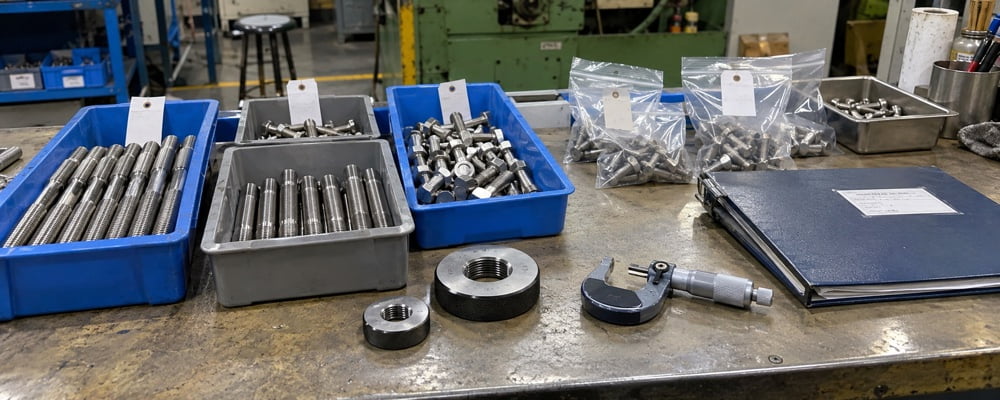
I use practical questions because they reveal whether a supplier has reviewed the requirement. A buyer can ask:
- Which drawing and revision did you review?
- Is the specified thread external or internal?
- Does your offer include the UNR rounded-root requirement?
- Which thread standard and edition will control production?
- Which class of thread will you supply?
- How will you manufacture the thread?
- How will you verify dimensional conformity?
- Will inspection occur before or after coating, if a coating applies?
- What material certificate and traceability records will be supplied?
- Have you listed all technical deviations in the quotation?
The answers should be reviewed by personnel who understand the application and the governing specification. A confident sales answer is not a substitute for a documented manufacturing and inspection plan.
Review documents as evidence, not decoration
Certificates can support supplier evaluation, but buyers should verify their scope, validity, issuing body, and relevance. A general quality-management certificate does not prove that a particular batch meets a UNRF thread requirement.
Depending on the order, buyers may request:
- Material test reports
- Heat or lot traceability
- Heat-treatment records
- Mechanical test results
- Dimensional inspection reports
- Thread inspection records
- Coating or surface-treatment certificates
- First-article inspection
- Nonconformance and deviation records
- Product marking and packaging confirmation
The project specification should determine the required document package. Buyers should avoid demanding irrelevant paperwork, but they also should not assume that a material certificate verifies finished thread geometry.9
Compare total procurement risk
Price remains important, especially for specialty alloys. However, the lowest unit price can become expensive if the thread designation is wrong. The total evaluation should include:
| Evaluation area | Procurement question |
|---|---|
| Technical conformity | Does the offer match the full callout? |
| Material control | Is the specified alloy, grade, and condition confirmed? |
| Manufacturing | Can the supplier control the required external root form? |
| Inspection | Does the inspection plan address the drawing requirements? |
| Traceability | Can records link finished parts to material and production lots? |
| Lead time | Does the schedule include material, production, and inspection? |
| Deviation control | Will the supplier seek approval before changing a requirement? |
| Commercial terms | Are quantity, Incoterms, payment, and freight clear? |
At CHENGGE, we review specialty-alloy fastener inquiries against the customer’s drawing and stated specification before confirming feasibility. Our business scope includes standard fasteners and custom parts, but that scope does not mean that every size, material, quantity, or thread requirement is automatically producible. I believe that early clarification is more useful than an unsupported promise.
Frequently Asked Questions
Is UNRF a finer thread than UNF?
No. UNRF is not a finer-pitch series than UNF. For the same nominal size, both can have the same threads per inch. The additional “R” identifies the controlled rounded-root requirement for the external UNR thread form.
Will a UNRF external fastener fit a UNF internal thread?
The matching nominal diameter, pitch, and compatible classes may allow the components to mate, but fit alone does not approve the combination. Buyers must confirm the internal-thread designation, class, tolerances, governing standard, drawing, and engineering requirements before assembly or substitution.
Is UNRF always stronger than UNF?
No. A rounded external root may reduce stress concentration and may support fatigue performance in suitable applications. However, strength and service life also depend on material, heat treatment, thread quality, preload, joint design, environment, and loading. The designation alone does not prove superior performance.
Can I replace UNRF with UNF if the diameter and TPI match?
I do not recommend making that replacement without written approval. Matching diameter and threads per inch do not confirm compliance with the external root requirement, class of fit, drawing, or project specification. A responsible engineer or authorized customer representative should evaluate and approve the deviation.
What information should I send when requesting a quotation?
Send the drawing and revision, complete thread callout, material specification, heat-treatment condition, dimensions, quantity, applicable standards, inspection requirements, documentation needs, surface treatment, and delivery terms. You should also identify any cyclic-loading or project-approval requirements that affect supplier evaluation.
Conclusion
The central issue in UNF thread vs. UNRF thread is not which option has a finer pitch. The real issue is whether the external thread requires the controlled UNR rounded root and whether the supplied fastener complies with the complete drawing and specification. Buyers should verify thread class, mating conditions, material, loading, inspection, and authorized deviation approval before accepting a substitute.
If you need specialty-alloy UNF or UNRF fasteners reviewed against your drawing, contact CHENGGE at [email protected] or WhatsApp +86 13564294198 for a technical and commercial feasibility review.
"Screw thread standards for federal services; part I", https://nvlpubs.nist.gov/nistpubs/Legacy/hb/nbshandbook28-1969p1.pdf. ASME B1.1 defines UNR external threads as Unified threads with a controlled root radius, distinguishing that root-form requirement from the ordinary UN-series designation. Evidence role: definition; source type: institution. Supports: The governing Unified inch-thread terminology distinguishes UNR external threads by a specified rounded root contour while retaining the applicable pitch series.. ↩
"Fastener Design Manual", https://ntrs.nasa.gov/api/citations/19900009424/downloads/19900009424.pdf. Unified-thread standards establish mating limits for corresponding external and internal threads of the same nominal size and pitch, allowing a UNR external thread to engage an appropriately classed UN internal thread. Evidence role: general_support; source type: institution. Supports: Unified external and internal threads with corresponding nominal size, pitch, and compatible tolerance classes are dimensioned to permit assembly.. Scope note: Dimensional compatibility does not by itself establish compliance with a particular drawing, product specification, coating condition, or engineering approval requirement. ↩
"Fastener Design Manual", https://ntrs.nasa.gov/api/citations/19900009424/downloads/19900009424.pdf. Analytical and finite-element studies of threaded fasteners show that peak local stress is sensitive to thread-root geometry and is generally reduced when a sharp transition is replaced by a controlled smooth radius. Evidence role: mechanism; source type: paper. Supports: Experimental or finite-element research shows that thread-root geometry affects the local stress concentration and that a larger smooth radius generally reduces peak stress.. Scope note: The magnitude of the reduction depends on the modeled thread profile, load, material behavior, and boundary conditions and does not establish a universal fatigue-life improvement. ↩
"NASA-STD-5020", https://s3vi.ndc.nasa.gov/ssri-kb/static/resources/nasa-std-5020.pdf. Fatigue studies of threaded fasteners identify the thread root—particularly near the first engaged thread—as a frequent crack-initiation region because local cyclic stresses are elevated there. Evidence role: mechanism; source type: research. Supports: Fatigue research identifies persistent cyclic stress concentrations as common crack-initiation sites and documents thread roots as critical locations in threaded fasteners.. Scope note: The actual initiation site can shift with joint geometry, defects, preload, corrosion, misalignment, and the applied load spectrum. ↩
"Investigations On The Fatigue Strength Of Threads Produced ...", https://docs.lib.purdue.edu/cgi/viewcontent.cgi?article=1019&context=icsp15. Comparative fatigue studies of rolled and machined threads report that manufacturing route can change root geometry, surface condition, and residual stress, thereby influencing fatigue resistance. Evidence role: mechanism; source type: paper. Supports: Comparative studies report that thread-manufacturing processes can alter surface integrity and residual stress, which in turn affect fatigue behavior.. Scope note: Results from one material, heat-treatment condition, or rolling sequence cannot be generalized quantitatively to every fastener. ↩
"Guideline for Bolted Joint Design and Analysis: Version 1.0", https://www.osti.gov/servlets/purl/929124. Bolted-joint analyses show that installation preload affects joint separation and the alternating stress carried by the bolt, making preload an important variable in fatigue assessment. Evidence role: mechanism; source type: research. Supports: Bolted-joint research explains that preload influences separation behavior and the fraction of an external cyclic load experienced by the fastener.. Scope note: Higher preload is not invariably beneficial; excessive preload can cause yielding or other failure, and the outcome depends on joint stiffness, friction, and service loading. ↩
"Fastener Design Manual", https://ntrs.nasa.gov/api/citations/19900009424/downloads/19900009424.pdf. Government fastener guidance and failure analyses document that failures may arise from improper preload, overload, hydrogen embrittlement, stress-corrosion cracking, galling, material defects, or incompatible service conditions, rather than from thread-root geometry alone. Evidence role: general_support; source type: government. Supports: Government engineering guidance recognizes multiple mechanical, environmental, and installation-related fastener failure mechanisms beyond thread-root fatigue.. Scope note: The relevance of each mechanism depends on the alloy, environment, coating, stress state, temperature, and installation process. ↩
"Compliance FAQs: Fastener Quality Act (FQA)", https://www.nist.gov/standardsgov/compliance-faqs-fastener-quality-act-fqa. Studies of coated threaded fasteners show that coating thickness can affect thread dimensions, while coating composition and surface condition can change friction during tightening and influence corrosion resistance. Evidence role: mechanism; source type: research. Supports: Research and technical guidance show that coatings add thickness, alter interface friction, and can provide or modify corrosion protection.. Scope note: The direction and magnitude of these effects depend on the coating system, thickness, application process, lubricant, substrate, and exposure environment. ↩
"ISO metric screw thread", https://en.wikipedia.org/wiki/ISO_metric_screw_thread. Inspection-document standards such as EN 10204 define certificates principally around material and test-result conformity; finished thread geometry must be established by applicable dimensional inspection records unless the certificate explicitly incorporates those results. Evidence role: general_support; source type: institution. Supports: Material inspection documents primarily report material identity, test results, and compliance with the material order; dimensional conformity requires separate product inspection evidence unless explicitly included.. Scope note: Some suppliers issue combined certificate packages that include dimensional data, so the document’s stated scope must be reviewed rather than inferred from its title. ↩